

Stories, Miscellany and Bits and Bobs from the Branch
We hope you enjoy this page where you can find stories, useful bits of information and other things from the branch that do not quite fit in elsewhere!
If you would like to provide us with some writing, some art, a Review, photos, a historical essay or anything else then please do let us know and we can publish you here
Book Reviews: Ursula K Le Guin
Another World is Possible
In this month’s book corner we present Ursula K. Le Guin – science fiction and fantasy author, environmentalist, anarchist, and all round good egg.
To begin with,
The Word for World is Forest
- When Terrans colonise “New Tahiti”, the indigenous population are forced to learn violence as a way of self-defence. The ecological devastation of their planet is echoed by the transformation of a people whose ability to dream provides alternative possibilities for worldbuilding.
The Dispossessed
- A Physicist from a Libertarian Socialist planet revolutionises the theory of physics and takes it to another world, with startling insight and startling results.
And to finish off with another quotation from the great woman: “We live in capitalism. Its power seems inescapable. So did the divine right of kings. Any human power can be resisted and changed by human beings. Resistance and change often begin in art, and very often in our art, the art of words.” 2014
Branch Administrator Unite LE524

Film Review: Palestine 36
Watching this moving and harrowing film recently brought home to me that the nightmare the Palestinians are living through now didn’t start in 1948, it started a long time before that, after the end of the first world war. The plot is a fictionalised account of the build up to, the impact of and the repression of the Arab revolt against the British in 1936, which lasted three years. This is seen through the eyes and experiences of families in a rural community and two middle class journalists in Jerusalem, who have links to and “friends” in the British occupying power, who are basically stringing them along in their nationalist aspirations.
Apart from the duplicity and double standards displayed by various officials about Palestinian concerns and future statehood, the colonial mindset, the casual brutality, and the anti-Arab racism are personified by the character of Captain Orde Wingate. Now this was a departure and gave me pause for thought. For Wingate actually existed, served in Palestine in this period, and is regarded as a second world war hero in “official” circles. I looked him up. Sadly, I can report that the violence and the atrocities he presides over in the film are in no way exaggerated for dramatic effect. They are very much in keeping with his record. Wikipedia tells me that he was posted back to Britain in 1939 because he was deemed too controversial and compromised as an intelligence officer. But he was still awarded the Distinguished Service Order, and ended up a major-general. How the British state likes to airbrush its crimes and misdemeanours!
If you get the chance, go and see Palestine 36. It’s beautifully filmed, with colourised archive footage brilliantly woven in. Most importantly it’s an Arab film made by Arab filmmakers. When I left the cinema I reflected on the last words of Breaker Morant, an Australian soldier scapegoated and shot by the British during the Boer War: “This is what comes of empire building.” Indeed.
Branch Organiser Unite LE524

The Death of Stalin (and all that)
Is Stalin and the system of rule he perpetrated a fit subject for satire? I pose this question given the furore that has surrounded the recent release of Armando Iannucci’s film “The Death of Stalin”. The criticism falls into three main categories: Such a world historic epoch is far too serious a subject to be treated in a humorous fashion; this links to the glorious Soviet Union should not be mocked; and the director has taken some diabolical liberties with history tovarish.
What was the motivation behind these jokes? A safety valve, a small act of subversion, or a bit of self-mockery to remind you not to get too big for your boots. Who knows? It is useful to remember though that subversive humour had originally been accepted as having an important role to play in the early Soviet Union, and not just in attacking the capitalists. After 1917 the satirical magazine “Red Pepper”, which wasn’t against mocking the egos and pretensions of the Bolshevik leadership flourished for a number of years, until it was suppressed by the Stalinists during the “socialist realist” period.
Even Stalin was capable of using humour to advance his political ambitions and undermine his critics, albeit the “jokes” were laden with malice and chauvinism. Some of his more famous (infamous) remarks were directed at Krupskaya: “Just because she uses the same toilet as Vladimir Illich doesn’t make her a Leninist”; and after Lenin’s death “If you don’t start keeping your mouth shut, the party will have to find itself a new Lenin’s widow”.
Back to the film then. Iannucci does not purport to be portraying a serious accurate history of Stalin’s death and its aftermath. From the start the intention is clear, to satirise the leadership of the Soviet Union in 1953 and the dysfunctional “first family”, And it is not a kind satire. The venality, vanity and cowardly viciousness of the politburo are fully exposed as they jockey for position. It’s not subtle, you will laugh one minute, then wince the next, as you are reminded of the cruel, arbitrary and lethally repressive nature of the system. These apparatchiks all have blood on their hands, not just Beria, but also “the reformer” Khrushchev.
And yes, extensive dramatic licence has been taken by the director, especially in the way the crowd scenes are handled before the funeral. Not all the politicians and military figures were on the scene immediately in March 1953 both before and after the death, and Beria’s fate is telescoped into a tight time frame to up the ante. But what an excellent cast does is capture the essence of character of the flawed individuals who made up the soviet leadership in 1953. How could they not be flawed, given they’d only survived as lackeys of the boss?
A number of commentators have felt that the film has been over-hyped in the “bourgeois press”. Maybe. But any film that provokes discussion about the nature of the Soviet Union, and mocks the pretentions and vaingloriousness of the leadership, even with sledgehammer jokes and slapstick, is one worth seeing. Humour in difficult times, especially self-mockery, is something the left should never be afraid of. It is a key element of our humanity, and will be a key element of our success.
I saw recently in the guardian that Professor Richard Overy, an excellent historian, recounted in a critical article on the film about a time when he had been in Lenin’s Museum in Moscow, and was given the opportunity to sit in Stalin’s chair. He was too uncomfortable to do it. “Easy to believe that the ghost of the dictator still haunts the room.” he wrote. Really? All the more reason for satire then….no one should be treated as being immortal.
Oh yes, that joke. See what you think.
After a hard day purging the cadres of the CPSU Comrade Stalin liked nothing better than to retire to his Dacha to smoke his favourite pipe.
One evening, after the limo had dropped him off, he sat in his chair and opened the top drawer in his desk. No pipe! He quickly pulled open all the desk drawers…still no pipe!
Stalin sat and brooded. After a while he picked up the phone and contacted NKVD (the Soviet secret police HQ:
“Comrade Beria, Stalin here. My pipe has gone missing. Obviously, some wrecking trotskyist counter revolutionary has stolen it. This is an attempt to destabilise the leadership of the Soviet Union. Put your best people on the case, do what you have too. I want that pipe found!”
Putting the phone down, Stalin sits for a while. Then something catches his eye under the desk. He bends down and finds…the pipe!
He laughs and has a smoke and looks at some files. An hour later he phones Beria back.
“Lavrenti old friend, my apologies, I found the pipe, it was under the desk all the time.”
“But, but Comrade Stalin…” stammers Beria, “how can that be? Fifteen have confessed already!!” Indeed.
2017

Brassed Off
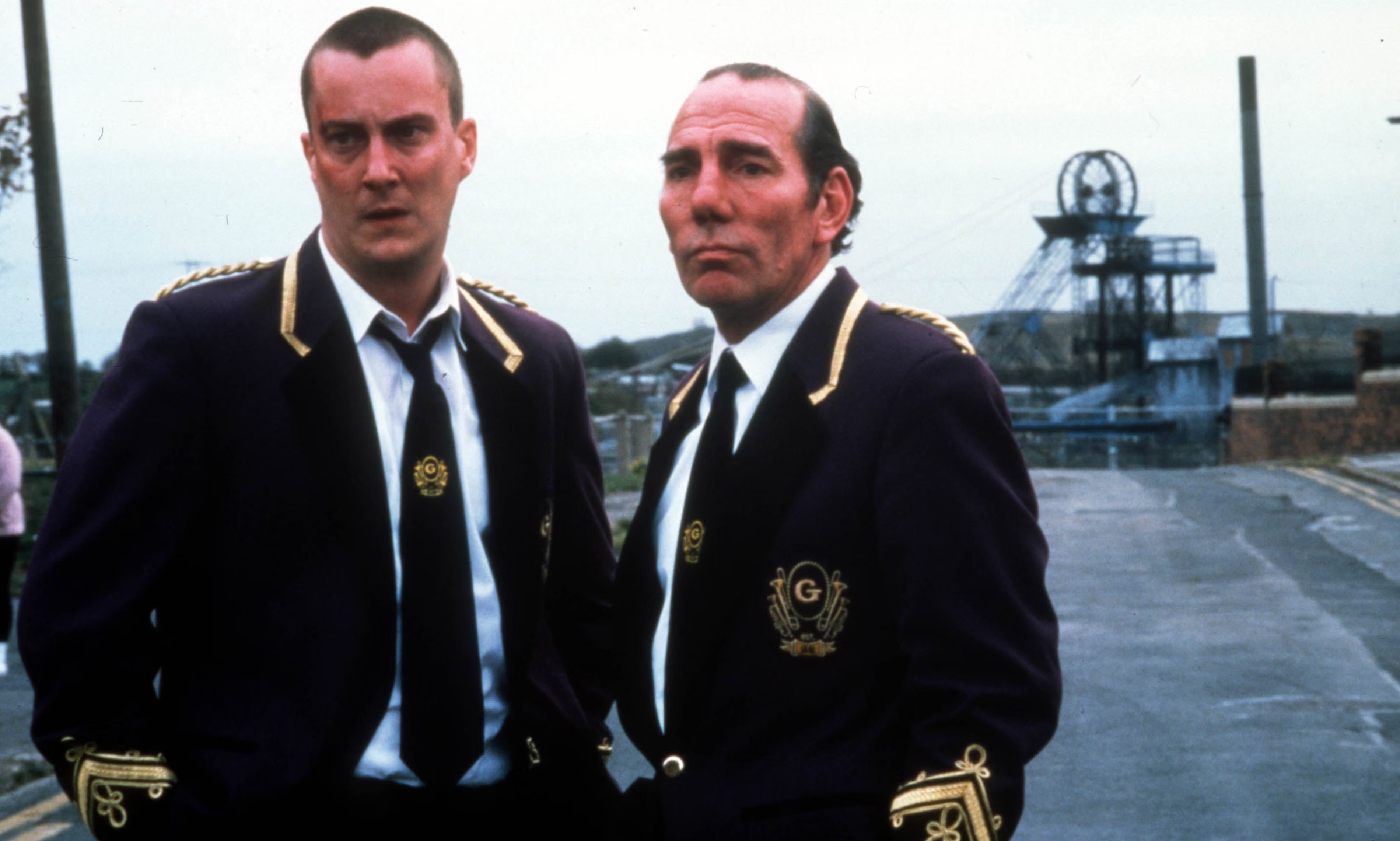
Amazingly, it is the 30th Anniversary of the Trade Union Film Brassed Off
It is a person centred view set in a fictional town that takes a 10 year view on the consequences, intended or otherwise, on men, their families, their communities and the social fabric of towns in the wake of the decimation of the Mining Industry following the defeat of the 1984 Miner’s strike
Having said that, it is equal parts hilarious and tragic, a real British classic with some fabulous moments including; every scene with a clown in it, the brass bands playing, a VERY good joke about the Tories, and Pete Postlethwaite’s speech at the end.
It asks the questions of how much music is worth when jobs are on the line, the desperation and destruction of community in places with no hope, and just what dignity means in these circumstances.
Without these jobs, a way of life has been lost
Branch Administrator Unite LE524
Welcome to the Bits and Bobs from the Branch Page
Explore the episodes
Podcast