
Resources
Redundancies
Periods of redundancy can be very distressing periods for everyone involved, whether they are at direct risk or not. For more information and advice please click learn more below.
Restructures
Similarly, Restructures are complex and difficult affairs, which can often also include redundancies, changes to working practices, assimilations, redeployments and relocations
Recognition
A workplace recognition agreement (WRA) outlines the formal relationship between a union and an employer, establishing the rights, responsibilities, and processes for both parties. A good agreement should: i) be comprehensive, clear, and mutually beneficial; ii) have written history/timeline to explain how it happened, as well as the challenges/ successes for each version. All workplaces and their WRA are different.
Strike Readiness
Workplace, Senior Management/Trustee, Organisation Mapping
What do you do with all this information?
Campaign Plan
Ballot Plan
Strike Plan
On the strike day
After the strike
1. Workplace Mapping including:
- Workplace colleagues
- RED – you’re not going to recruit/talk to due to their role (e.g. CEO, SMT…) or an individual’s anti-union stance…
- ORANGE – Workplace colleagues that you might approach with caution… e.g., Executive Assistant to CEO – whilst they might be union sympathising, perhaps they might be likely to tell their boss. However, if you want them to tell their boss….
- GREEN – Workplace colleagues who are union friendly/positive (if not already members!)
- Current members.
- Know which teams are union dense / others that you need to focus your recruiting efforts.
- Which staff groups/networks are they in? (e.g., staff football team, or equality network…)
- What are they interested in? (e.g., parents interested in more family friendly policies or persons with an interest in gender pension gap)
- What skillsets do they have? (e.g., a person in the proposal development team might know lots about what the funders are after and the information that the workplace uses – or a person in finance is great with excel/data analysis and can explain the workplace annual financial report, or a person in HR who can on occasion give you an idea about workplace focus issues…)
2. Senior Management/Trustee mapping including:
- Who are the senior managers/trustees? Who are the most influential? Do you know their agendas? Really know who they are – do they have dependents/support a football team? Are there any synergies with the staff, Workplace and/or Unite strategies?
- Go onto LinkedIn and other sources to see who their connections are. Do you have any mutual connections that might be able to help you get intel on them? Are the senior persons/trustees involved with other charities/organisations that you could exploit? Can the LE524 branch put you in touch with other reps – or find someone to meet who knew them before they joined your organisation?
- What are their interests? What are their previous achievements? What elements of their professional brand would they be interested in protecting?
- Can you find commonalities or know what your leverage areas are?
3. Organisation mapping
- Company’s public Information – incl. public strategies, missions, connections, finances, statistics…
- Company’s private information – know the above for internal. You as staff will know the challenges that the workplace is working hard at to mitigate (e.g., challenges getting CRM system to talk to finance system, or issues with staff turnover/culture…). Does the company look to others/ “comparators” for direction? Who is the company bringing in to help them (e.g., financial consultants, change managers…)? Has a new system implementation been delayed/ stopped? What is the company’s financial status? Where does the company get its money from (and what are the priorities of those places)?
- How different are the internal/external perspectives? Often workplaces in our sector try very hard to project a nice image externally which can often be very different from the lived experience of staff. (e.g., we advocate for the rights of the poorest people, but we won’t allow staff unionisation).
- Are there any of the above for the company that align with Unite strategies?
What do you do with all this information?
You will now have a lot of information that will be useful for a variety of reasons – perhaps at the points of negotiating pay, terms and conditions, but also at other points (including campaigns) too. It’s important that this information is kept current – but the onus shouldn’t be just on one person or just the workplace reps. Do see what information your workplace can give you as reps – as an example, Health and Safety Reps can ask for and expect to receive a lot more information than perhaps you might think. It’s very powerful to use an organisation’s own information against them. Can you allocate responsibility to different persons, for example, information on new staff joining might be something that HR can agree to send automatically to workplace reps or the workplace rep email address, so you don’t have to chase it.
There are occasions when an immediate strike is necessary and this should happen (e.g., unsafe workplace). However, generally a strike should only be considered once other actions have happened.
It’s difficult to compile this document to prepare for all eventualities, but we thought that we would share a couple of cases that show how strikes can happen… we’ve tried to anonymise the cases below using multiple different examples of strikes we have known.
Case #1:
Annual negotiations around pay, terms and conditions weren’t going well. The workplace reps got a mandate from the members saying that the 0% offer from management was so poor that they would be prepared to go out on strike. The workplace reps did a detailed survey of members that not only was around the cost of living which would resonate with all persons, but also included information that particularly aligned with the company’s mission as a housing provider (e.g. X% staff using the showers at work because they couldn’t afford at home). They devised an escalating awareness campaign (social media and in real life), which culminated in staff members’ MPs asking questions in Prime Minister’s Questions/speaking in different fora. Despite all this, the employer wasn’t moving, so a strike was needed. The workplace reps chose an important time, just before Christmas, as the workplace had an important revenue generating campaign at this time that was responsible for the company getting a substantial proportion of their annual income. They went on strike and eventually were given a much better offer which the members voted to accept.
Case #2:
Staff were told that their shift finish time was now 9pm (it was 7pm before). The impact was that by the time they had done handover, waited on suppliers, performed the end of day works etc, they were leaving at 11pm and getting home at 12am. This wasn’t acceptable, because they weren’t getting adequate rest before working the next day, which they are entitled to under UK law. Management said that other workplaces had brought in longer days without problems, so these workers should just accept it. They exhausted routes with management explaining the situation, so needed to escalate. They brought in Unite, with people outside the workplace explaining the situation and getting service users and the public to click on the QR code, which sent an email directly to the three key senior managers (CEO and two Directors). This didn’t get a result, but it started getting them annoyed. The next step was to have Unite presence outside the member’s workplace as before, but also outside the offices of the workplaces where the senior managers were – again with more QR codes to flood the senior persons’ inboxes with emails, signed by staff, public and service users. This didn’t change these senior persons’ minds, but it did make them more agitated. The next step was to have a Unite presence outside other workplaces that the senior persons were involved with (e.g. one was a trustee at a charity), so more QR codes resulting in more emails. The email system now crashed because of all these emails and these other workplaces were raising questions about whether this was acceptable from a reputational perspective for them. In addition, it came to light that the staff who relied on work visas were being threatened with “if you promise not to strike/stop involvement with Unite and we’ll re-sponsor your visa”… the final straw was an open meeting for the company, where Unite was outside picketing, so again, all attendees were greeted with the QR code. Unite had submitted a question to be raised from the floor in time with the meeting procedures. It was sufficiently well worded that it resulted in several follow up questions from other attendees on the floor. In addition to this, there was the media coverage that Unite was generating with multiple hashtag campaigns on twitter/instagram, including hashtagging the senior people. The end result: Unite and management sat down to talks, the threats about visas was removed and the members had the 9pm shift end time revoked.
Both of the cases (hopefully) show that strikes/campaigns need to be escalating in nature& planned.
Campaign Plan…
What does yours look like? What resources do you need and when across the timeline? Bring in your Unite Regional Officer as soon as possible; they will help finesse or provide other support/ suggestions.
Ballot Plan…
If the campaign doesn’t have the results needed, you might have to ballot for strike action. Annex 1 is a suggestion with some steps.
Strike Plan… this might be part of your campaign plan, but if you do consider striking, you will need a plan. What does your plan look like? Get everything you need into one document. What resources do you need and when across the timeline?If you need Unite (and we would suggest you do!)… bring in your Unite Regional Officer and your LE524 Branch early. When will you strike? When is a good time? Is there a busy day in the office? A day when the fire alarm goes off and people have to walk past you? Can you engage other organisations in your office building (e.g., co-working places)… a week of strikes, or every Thursday for a month? Can this be used as a campaign to get new members if they sign up in time, so they get strike pay too? Who can you get to help? – other members of the LE524 branch, allies/ partners? Notice to whom/when – what notice should you give to employers? Who is creating an FAQ for staff/members (pay offer facts, strike pay info, picket details). Who is drafting external comms? (Annex 2 is an example flier that you could distribute or link to a QR code. Who is talking to the media? Can you bring in Unite community groups? Will there be a strike fund? If yes, will you want it managed by the branch or centrally by Unite? (generally the latter is for larger organisations and/or longer campaigns). How will you prove that your members aren’t working? What do you need to help get them paid (Unite has a strike fund of £70/day, perhaps put a motion to LE524 branch to top up to living wage rate if it’s not going to be a national campaign)?
On the strike day:
- Clear start and end times.
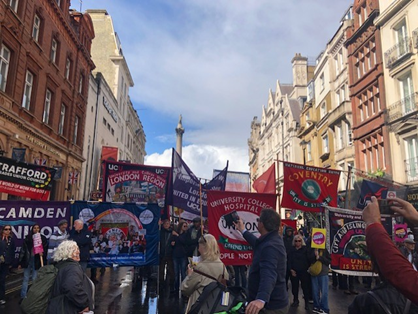
- Merchandise – flags, signs, shop steward armbands, whistles, badges/stickers..(ponchos if raining)
- Roles – picket stewards, difference between rally/picket, locations?
- Photos/Videos taken and shared?
- Media interviews?
- Leaflets to distribute/QR code?…
- Megaphone?
- Chants beforehand – (e.g., “what do we want”?, “fair pay”. “When do we want it”? “Now”)
- Invitees – Unite community members, branch committee/members; Regional Officer…
- Small speaker to play spotify playlist – music can be a good way to get attention & keep spirits up.
- Snacks/food if it’s going to be a while? Help keep up morale.
- Agreed “what you can/can’t do” for those attending (e.g., not take up all pavement…)
- Agree speakers to have conversations with trustees/management as they go in/out of the building?
- Think about weather – if it’s raining, do you have Unite umbrellas/ponchos…
- If your picket is on a day with a fire alarm, will they have to come past you outside the front door.
After the strike:
What happens now? i) Debrief; ii) Next steps (escalation/resolution); iii) Lessons learned; iv) Thank supporters; v) members survey; vi) update sent to members/other stakeholders
Workplace Reps Elections
Unite requires that workplace reps are re-elected on a three yearly basis.
- Notify all current UNITE members that workplace elections are happening.
Will your elections include all members (e.g., CEO and Senior Management)? Inform employees about the election and explain the role of a union rep. Set a timeline for nominations, voting, and results. Ensure the process is inclusive (all eligible members should have a say).
- Call for Nominations
Ask members to nominate candidates who are willing to stand for election. Set a deadline for nominations (at least two weeks to allow for people to see/decide to stand if they are on leave). If only one person is nominated, they can be elected unopposed.
- Election Process
The voting method should be fair and anonymous (e.g., ballot boxes, postal votes, or online voting). The voting system should be clear and the timeframe too (ballot process open between 9am-5pm). Do you need an independent ballot officer?
- Announce the results
Once voting is complete, count votes fairly and announce the winner. Consider transparency, e.g., have (independent) scrutineers to observe the count. Complete the form that Unite has shared with the new rep details and email to your regional officer. Unite will update its’ records, contact the reps offering training.
- I want to be prepared, but where do I go for more information? We would suggest you find out what happened last time, or find out how voting was done for recognition.
- Which is the best method to use? If you’re all in the office on one day, perhaps numbered balloting slips for members to put in a box is best. However, perhaps if your company has an environmental mission, perhaps an online approach would be better.
- Why might I need an independent ballot officer? Sometimes elections can get fraught, especially if strong persons were standing against each other. The branch and your regional officers are there to help you.
- What does being a rep mean at my workplace? All workplaces are different. Ideally, your workplace would have a one page document on what is involved. What training you need, how much facilities time (paid time off to do union works) and how much annual training time (paid time off to do union training) – and lots of other things. If you are elected to be a rep, we would strongly suggest that you enrol on at least UNITE’s “Workplace Rep 1A” course. The branch is also doing regular knowledge share days (one day course where we share lots of tips and tricks with you and other reps).
- If I would like to be a rep, what would I need to do? Do you think that others would vote for you? Find out how you go about standing as a candidate? Do you know who else is interested? Is there anyone to help you with your campaign? Does your workplace have lots of reps in one division, but not in another?
- Who is allowed to stand for election? If you have a recognition agreement, see if it covers all staff, or certain levels. You might have SLT staff members who are also union members, but you might not want to have them as workplace reps. From UNITE L524 perspective, candidates should be current members and not in arrears.
Common Trade Union FAQs
We all understand that only by working together we can create long-lasting & meaningful change. You don’t have to go back far in the UK history to know that without unions, we’d all be working six & a half days a week, women would have no votes, workplaces would be unsafe… & many things in addition to those.
Find out the answers to some common Trade Union FAQs here